
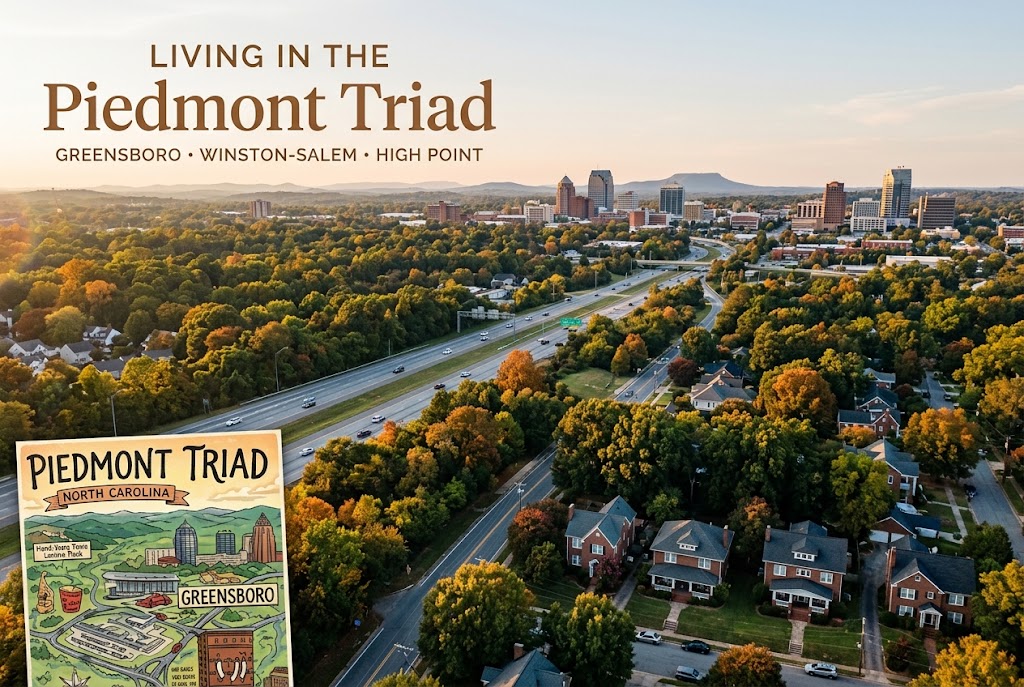
Quick Answer: The Piedmont Triad (Greensboro, Winston-Salem, and High Point) offers a significantly lower cost of living and higher square-footage value than Raleigh or Charlotte. Known as a "20-minute metro," the region features 15–25 minute airport commutes via Piedmont Triad International Airport (PTI), top healthcare hubs like Cone Health and Atrium Health Wake Forest Baptist, and diverse housing from historic 1920s Craftsman bungalows to modern custom builds on multi-acre lots.
What Is The Cost Of Living In The Piedmont Triad Compared To Raleigh Or Charlotte?
The Piedmont Triad offers a significantly lower cost of living and more affordable home price per square foot than both the Raleigh-Durham (RTP) and Charlotte metro areas, while keeping commute times under 25 minutes across the region.
How Far Is The Piedmont Triad From The Beach And Mountains?
The Triad sits centrally located in North Carolina, roughly 90 minutes east of the Blue Ridge Mountains and under 4 hours west of the Atlantic coast.
What Major Airport Serves Greensboro, Winston-Salem, And High Point?
The region is served directly by Piedmont Triad International Airport (PTI) in Greensboro, located within 15–25 minutes of all three anchor cities.
What Are The Main Job Market Drivers And Top Employers In The Triad?
The Triad boasts a diverse economy across healthcare, aviation, manufacturing, tech, and higher education. Key regional employers include:
Healthcare: Atrium Health Wake Forest Baptist, Cone Health, Novant Health, LabCorp
Aviation & Manufacturing: HondaJet, Volvo Group, HanesBrands, Qorvo
Higher Education: Wake Forest University, UNC Greensboro, High Point University, Elon University
How Do The School Districts In The Triad Compare?
The region is served primarily by county-wide public school systems:
Guilford County Schools (Greensboro/High Point): The 3rd largest district in NC, known for top-ranked magnet and early-college high schools.
Winston-Salem/Forsyth County Schools: Offers specialized arts, STEM academies, and IB programs.
Surrounding Counties: Davidson and Alamance counties offer high-performing, community-focused school systems.
What Architectural Styles Of Homes Are Most Common In The Triad?
Housing styles vary significantly by era and micro-location:
Historic (1920s–1940s): Craftsman bungalows and Colonial Revivals in urban neighborhoods like Ardmore and West End (Winston-Salem) or Fisher Park (Greensboro).
Mid-Century (1950s–1970s): Brick ranches and split-levels across established suburban corridors like Green Valley and Forest Oaks.
Modern & Custom Builds: Contemporary single-family homes on multi-acre lots in northern Guilford County (Summerfield/Oak Ridge) and Clemmons.
What Is The Weather And Seasonal Climate Like In Central North Carolina?
The Triad experiences a mild four-season humid subtropical climate. Winters are short and mild (highs in the 40s–50s°F), springs and autumns are long and vibrant, and summers bring warm temperatures (highs in the upper 80s°F) ideal for outdoor lake and park activities.
What Are The Top Outdoor Activities And Day Trips Near The Triad?
Residents enjoy quick access to outdoor recreational hubs like Pilot Mountain State Park and Hanging Rock State Park within a 30-to-45-minute drive. The region also features extensive local trail networks (like Greensboro's Atlantic & Yadkin Greenway), the Yadkin Valley Wine Region, and easy weekend trips to Asheville (2.5 hours) or the NC coast.
What Unique North Carolina Home Buying Costs Should Out-Of-State Buyers Expect?
Due Diligence Fee: A non-refundable payment made directly to the seller upon contract acceptance that secures a set period for inspections, appraisal, and title work.
Closing Costs: Buyers should budget 2% to 4% for closing costs, covering lender fees, title insurance, property taxes, and regional inspections (such as home, termite, and radon testing).
What Are The Best Suburban Towns Surrounding Greensboro And Winston-Salem?
| Town | Highlights & Location | Ideal For |
| Summerfield & Oak Ridge | Luxury homes, spacious multi-acre lots, top-rated Guilford County school pipelines, peaceful rural feel. | Buyers seeking estate lots and top public school pipelines. |
| Kernersville & Clemmons | Situated centrally between Greensboro and Winston-Salem; central commutes and high square-footage value. | Commuters wanting central access to both major Triad cities. |
| Jamestown | Historic small-town feel, lakeside living along High Point City Lake, immediate access to Greensboro and High Point. | Buyers wanting historic charm and lakeside recreation. |
Do You Need A Car To Live In The Piedmont Triad?
Yes. While downtown cores like Downtown Greensboro and Winston-Salem's Innovation Quarter are walkable and bikeable, the broader region is car-oriented. Main transit arteries like I-40, I-85, I-73, and US-421 make driving across the "20-minute metro" straightforward with minimal traffic compared to larger national metros.
Should You Rent First Or Buy A Home Immediately When Moving To The Triad?
If you know your long-term neighborhood or school preference, buying right away lets you take advantage of the Triad’s favorable price-per-square-foot compared to Charlotte or Raleigh. However, if you are unfamiliar with the distinction between the three primary cities, renting for 6 to 12 months in a central corridor (like Kernersville or West Greensboro) gives you time to experience everyday routines, commute patterns, and local micro-markets.
Navigating a relocation to the Triad requires local market insight. Connect with Jennifer Pedersen at Jennifer Pedersen Homes to compare neighborhoods and build a custom home search strategy.
Check out this article next