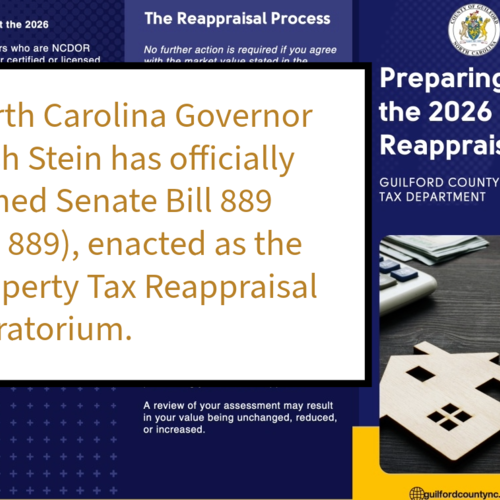



Just days before local municipalities were set to finalize their budgets, state lawmakers ratified Senate Bill 889, the “Property Tax Reappraisal Moratorium.” Signed into law by Governor Josh Stein, the legislation places a strict freeze on 2026 property revaluations, forcing counties to ignore newly updated real estate values and revert to older valuations.
For Guilford County, Greensboro, High Point, and surrounding districts, that means property taxes this summer must be calculated using frozen values determined back in 2022.
While a pause on skyrocketing home valuations might sound like a victory for the average homeowner, it fundamentally crippled the city's tax base.
This $16 billion variance changes the yield metrics for local revenue generation. Under the projected 2026 revaluation values, one penny on the tax rate would have generated $5.6 million. Utilizing the mandated 2022 values, that same penny yields $4.0 million. To maintain stable funding for existing services, the city adjusted the nominal tax rate upward to balance the lower valuation base.
Simply put: under the state-mandated old values, each penny does less work. To fund basic operations, the city had no choice but to adjust the rate sharply upward.
| 2022 Base Property Value | Projected 2026 Revaluation Jump | Bill Under Frozen 2022 Values (79.85¢ Rate) | Bill Under Expected 2026 Values (Lower Rate) | Direct Financial Impact |
| $128,700 | +82% | $1,028 | $1,368 | Saves $340 |
| $307,300 | +22% | $2,454 | $2,182 | Pays $272 More |
For Potential Sellers: If their property value has spiked 82% since 2022, they are sitting on an absolute mountain of equity, plus their tax bill just got shielded by this moratorium. This is the perfect time for them to cash out before a future revaluation catches up.
For Potential Buyers: Middle-market buyers need to factor the updated, higher 79.85¢ tax rate into their estimated monthly mortgage payments when looking at homes.
City officials point out that the no-revaluation approach makes the immediate tax impact proportional to older values, effectively shielding lower-income homeowners from sudden, massive jumps that a true 2026 revaluation would have triggered. However, middle- and upper-market homeowners will now pay significantly higher rates on properties that haven't officially been marked up.
Rising Costs of the "Bare Essentials."
City Manager Trey Davis and Mayor Marikay Abuzuaiter have maintained that the budget is strictly an exercise in preservation, not expansion. The city had already implemented a hiring freeze for nearly a year, consolidated internal assets, and chopped full-time equivalent positions to lean out operations.
"These are not luxury services," Davis noted. "They are the essential services that residents rely on every day."
The $485.3 million General Fund budget includes critical funding for 30 new police officer positions, expanded coverage for the Behavioral Health Response Team, and restored operational hours at community lakes and recreation centers.
Yet, inflation has left deep marks on the city's ledger. Over the last four to six years, basic municipal goods have surged:
Water treatment chemicals: Up roughly 50%
Stone materials: Up roughly 66%
Asphalt costs: Up roughly 38%
To keep up with infrastructure and environmental compliance, the City Council also approved a staggering 11.4% increase in the water utility rate. This summer, local residents will feel the squeeze from both their tax assessments and their utility meters.
The Guilford County Board of Commissioners was prepared to adopt its own balanced, historically low 61.90-cent tax rate earlier this month. But the passage of SB 889 immediately wiped out a projected $83.7 million in expected county revenue.
County officials abruptly paused their scheduled June 18 budget adoption to hold emergency work sessions. Chairman Skip Alston warned that the county is caught between a rock and a hard place: they must service thousands of new residents who have moved into the county since last year, but they no longer have the updated tax base to pay for them.
Behind closed doors, county leadership is weighing whether to absorb the blow via deep service cuts to emergency services, public schools, and infrastructure, or follow Greensboro's lead by tacking a significant rate hike onto the old 2022 values.
By state law, Guilford County must finalize its budget ordinance by June 30. For local property owners already dealing with Greensboro’s double-digit rate hike, the upcoming county vote promises to make an already expensive summer even costlier.
Check out this article next